The written response for this brief consists of two parts:
A 150–200-word statement that articulates how your group’s explorations helped you to reflect on, deepen, or shape your own position as a practitioner in context of Disability Justice and accessibility (being as specific as possible).
Much like the looser, flexible models of time this brief asked us to explore, I found my own position within this project felt slippery; difficult to grapple with and define in the educational context. As I have a health condition that is considered a disability, I have a deeply personal connection to the themes this provocation raised, and found it both interesting and discomfiting to lift the lid on something I don’t ever explore in my work. Reading Ellen Samuels’ Six Ways of Looking at Crip Time (2017) was the first time I had read passages of text that so poetically and completely described experiences that I share and live through. I found it compelling to explore this in the context of a group project for educational purposes; and Samuels’ reference to her educational experience — ie. that she “loved” the rhythm of her PhD work as it related to crip time — felt completely at odds with my own experience. This prompted group discussion about our experiences of educational rhythms, and ultimately led to our critique of it. Having tried to rigorously fit in to the normative rhythms that educational establishments present, for fear of letting my disability ‘win’, I felt a complex relationship developing to the work we made for this project, as well as how I encounter and ask for support in the educational context. I enjoyed the critical approach to the work we made as a group, and think that the marrying of slow, tactile making with exaggerated forms of publication is an exciting way to intervene in the ‘killing rhythm’ we identified. This being said, I think the work we made is just the beginning of a larger personal inquiry into how my position as a disabled practitioner influences my work, both in the content of the work itself, but also the systems in which that work is situated.
An annotated bibliography consisting of 6 references that shaped your response to the brief, including: 2 texts from the reading list, 2 texts that you find outside the reading list, 2 design practices/projects
DiSalvo, C. (2012) Adversarial Design. Cambridge, MA: MIT Press. Available from: ProQuest Ebook Central. [25 February 2025].
DiSalvo’s piece on adversarial design illustrates how design has the potential to “give form to problematic situations” (pp. 118), and comments on the practice of participatory design; especially that which opens “the design process beyond the experts [by] including those who might be affected by the designed thing” (pp. 124). Our project has aimed to find this “form” and apply it to a problematic situation in order to illustrate or make visible the struggles of those who are disabled and chronically ill in the context of the education system. Our exaggerated, oversized publications engage with publics in a way that makes communal a normally private process (making an Extenuating Circumstances claim), and therefore engages with the “agonism” (pp. 115) that DiSalvo speaks on. Since we have situated our work within the context of CSM, our work exists in direct opposition to the structure we are bound by; it creates conflict by existing.
Weinmayr, E. (2014) ‘One Publishes to Find Comrades*’ in O. Klimpel (ed.) The Visual Event: An Education in Appearances. Leipzig: Spector Books, pp. 50 — 59.
Weinmayr discusses the value of publishing print matter — from posters, to zines, to newspapers — and the effects its participatory, communal nature can have. The relevance to our project is twofold; not only does our project aim to “reclaim the space in which we imagine ourselves and our collectivity” (pp. 59) but also, in our methods of making, the act of “creation becomes as important to putting [it] to the public” (pp. 55). During our process, we found that paper weaving became both an act of meditation (as a representation of flexible, “crip” time), and an antagonistic, radical act. The method through which we distorted our text became an act of disfigurement and resistance, as well as allowing us to work at a pace which wouldn’t cause stress or overwhelm. By producing our publications collectively, and circulating them to be engaged with communally (particularly in the environment of CSM), the shared authorship and the collective use of them distributes the weight of institutional bureaucracy.
Samuels, E. (2017) “Six Ways of Looking at Crip Time”, Disability Studies Quarterly, 37(3). doi: 10.18061/dsq.v37i3.5824.
I found Ellen Samuels essay to be instrumental to how I approached this brief and how it informed the group discussion around crip time. As I live with an autoimmune disease and chronic health condition, I resonated deeply with her passage on the intertwined “bodymind” and how modern culture at large “tells us to divide the two and push the body away from us while also pushing it beyond its limits”. For me, this is particularly relevant in the educational context, and as a group we discussed how the scheduling and assessment systems we experience at university can lead to overwhelming, exclusionary expectations of work, attendance and participation. Samuels discusses crip time as being “forgiving”, and discusses ideas of flexible, loose time, that can be “beautiful” for those with disabilities and chronic illnesses. In our process of creating distorted imagery, we wanted to take on this idea of flexibility and beauty through weaving; forcing us to slow down and take a measured yet critical approach to image making. Despite perhaps existing within the normative rhythm of a project structure, the slowness we were able to begin our work with felt like a subversive act, existing in opposition to the normal pressures we experience when working to a deadline.
Hedva, J. (2022) Sick Woman Theory. Available at: https://topicalcream.org/features/sick-woman-theory/ [Accessed: 25 February 2025]
In Hedva’s influential text, they speak on their experience of the impacts that chronic health conditions have, not just in reference to the physical symptoms and bodily struggle such illnesses incur, but how the societal expectation of active “presence”, in all its forms, excludes those who do live with chronic illnesses. Hedva refers to the inability to attend protests, posing the question “How do you throw a brick through the window of a bank if you can’t get out of bed?”. As it relates to our project, this discussion of domestic protest and local subversion influenced our thinking on how we could critique a system while within the system; operating from the inside. Hedva’s subsequent reference to the severe “common vocabulary” of medical terminology is also relevant; particularly the idea that one must use “the oppressor’s language” in order to be widely understood. This influenced our meta-approach of using the language of the institution to then critique said language and system. By using documents and regulations made by the university and exaggerating their exclusionary, inaccessible language and qualities, we could effectively illustrate our position that, for those in active trauma or who have disabilities, the process of making an EC claim is not only overwhelming but also contradictory to the support that the university supposedly offers.
Darling, J. (2022) Epistemologies. [Sculpture] Towner Eastbourne.
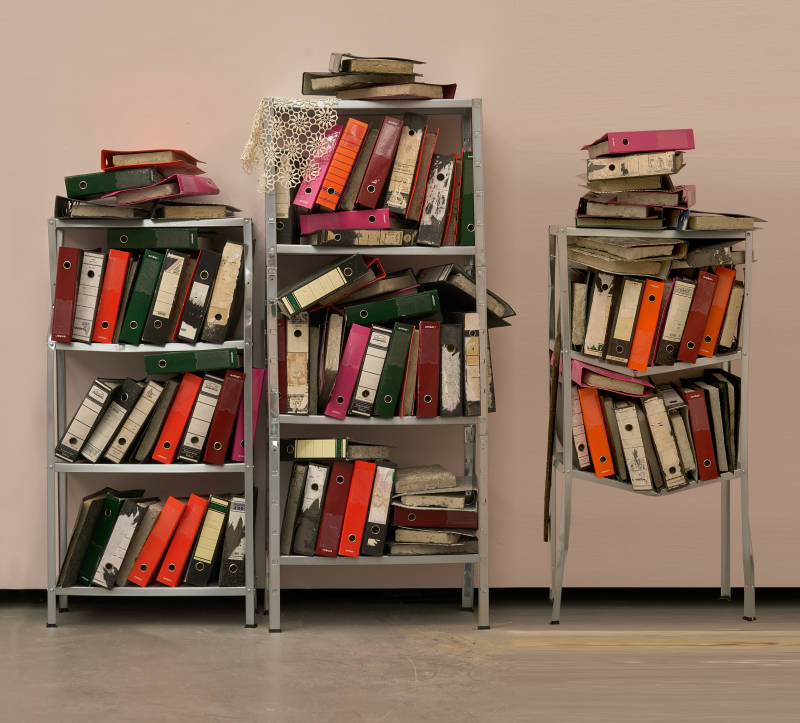
Jesse Darling’s piece Epistemologies, which is part of a larger body of work, explores themes around vulnerability in the context of disability and gender expression and, more specifically, the weight and burden of bureaucracy for those in positions of precarity. As we were exploring a similar subject as it relates to educational bureaucracy, the nature of Darling’s concrete filled ring binders is both visually and thematically relevant; pushing us to think of exaggerated modes of presentation. While shelves bow under the (literal) weight of the binders, we approached our field of inquiry within the administrative language of the institution itself; using regulations provided by the university to distort and exaggerate. Darling’s work also propelled us to look at the notion of obstruction, and making a once functional object useless or un-usable through distortion and manipulation. His presentation of the work — the binders situated on office shelving with other familiar objects around them — was also important in pushing us to think of how we could situate our work within the context of UAL to effectively illustrate our point.
Lazard, C. (2018) CRIP TIME. Video (colour, sound). 10 min. Museum of Modern Art: New York
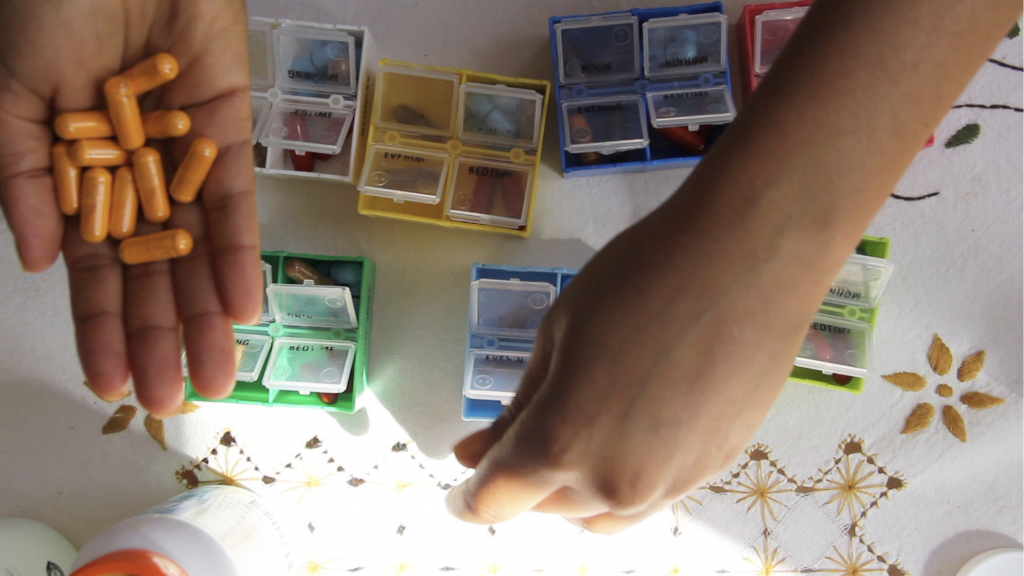
Carolyn Lazard’s video piece CRIP TIME is a 10 minute film that tracks the weekly ritual of pill-pot filling, publicly presenting a usually hidden task that many people with disabilities and chronic illnesses undertake. The act of making this task public is arresting, both in its mundanity and its deliberate slowness. Lazard’s work and its resistance to normative time structures shaped our thinking in how we could choose a deliberately slow process of making, but also create a work that is to be experienced over time, rather than fleetingly. The process of weaving within our project challenges academic and capitalist rhythms by prioritising the slow work of the hand, which acts in resistance to normative scheduling and project deadlines. This, in combination with the performative nature of our concertina outcome, explores the slippery nature of time for disabled and chronically ill people; both in its method of production as well as the time it takes to read or engage with the piece. By making the experience of reading the EC claim regulations communal, we intervene in a usually private process that can bring about feelings of isolation and shame, while exaggerating the length of time it takes to make a claim itself.
Leave a Reply