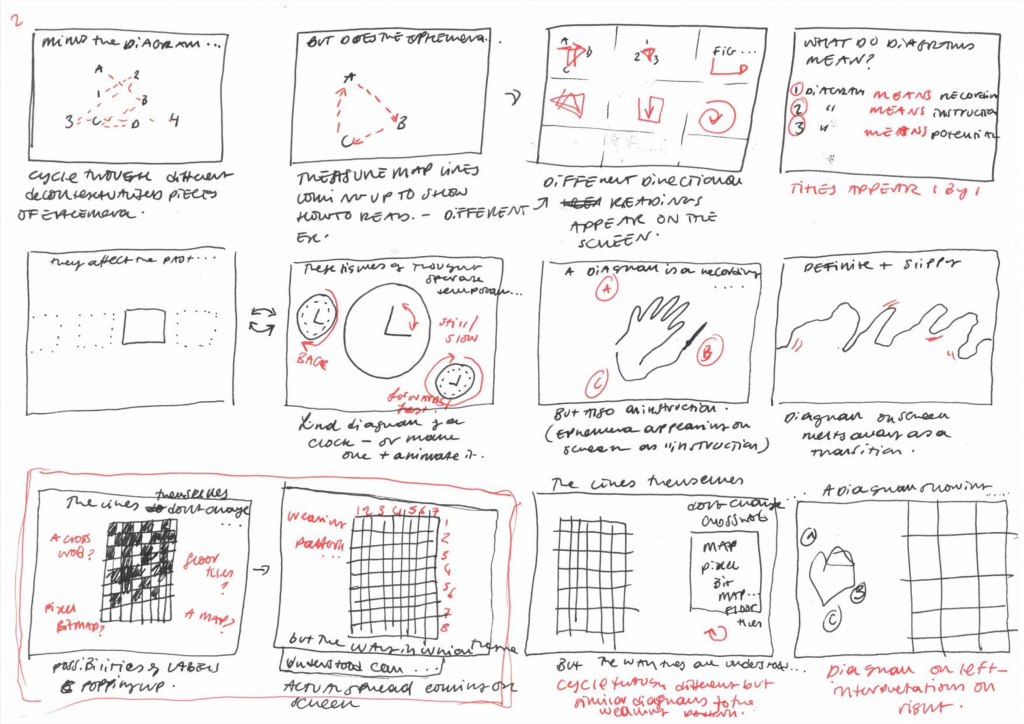
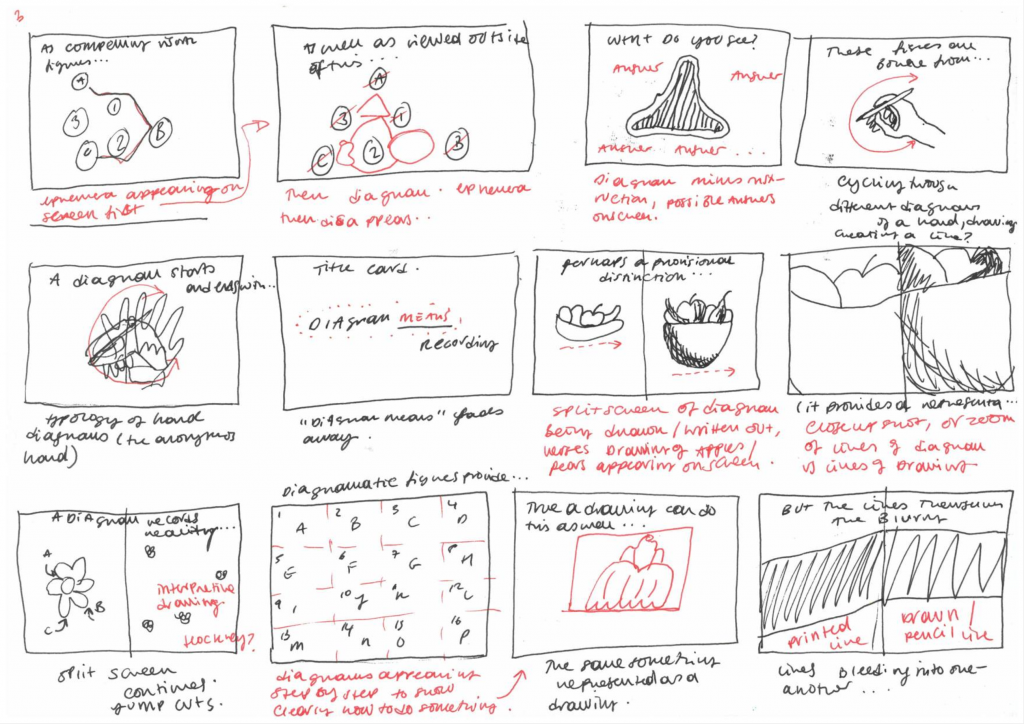
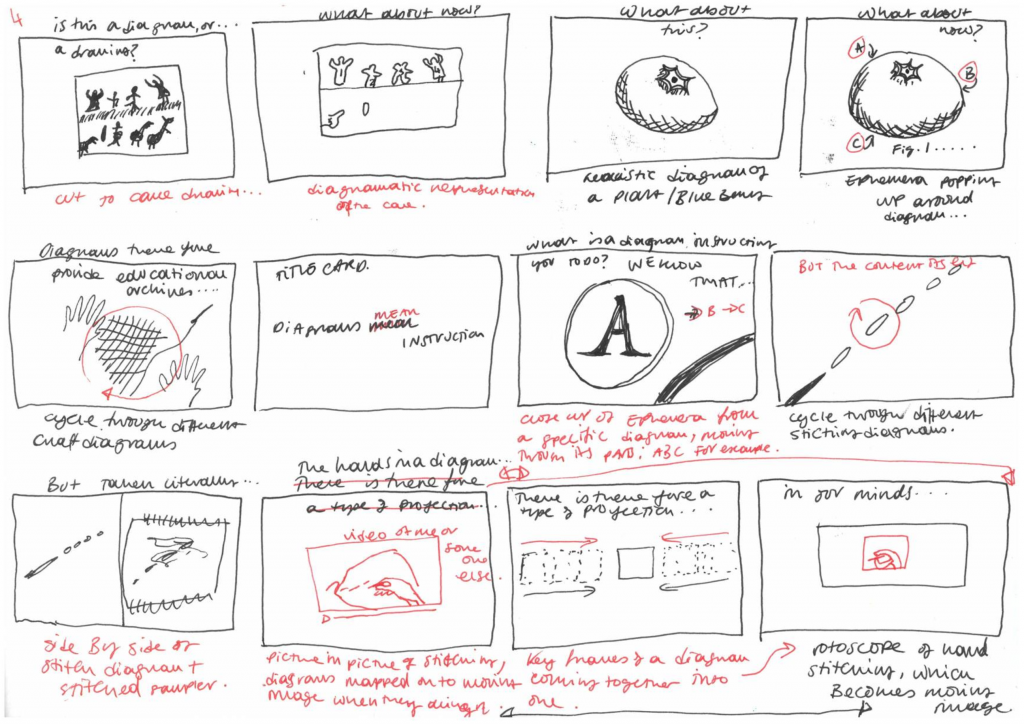
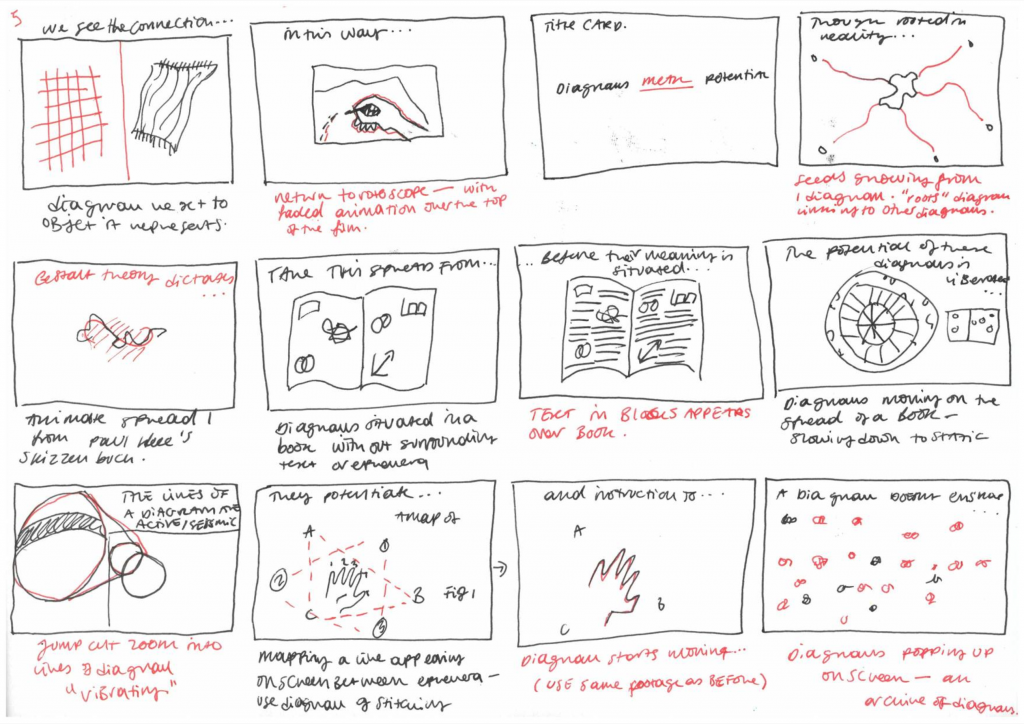
This storyboard was made after writing the first draft of the below script. Initially I wanted to make a film, but ended up adapting the narrative for a book.
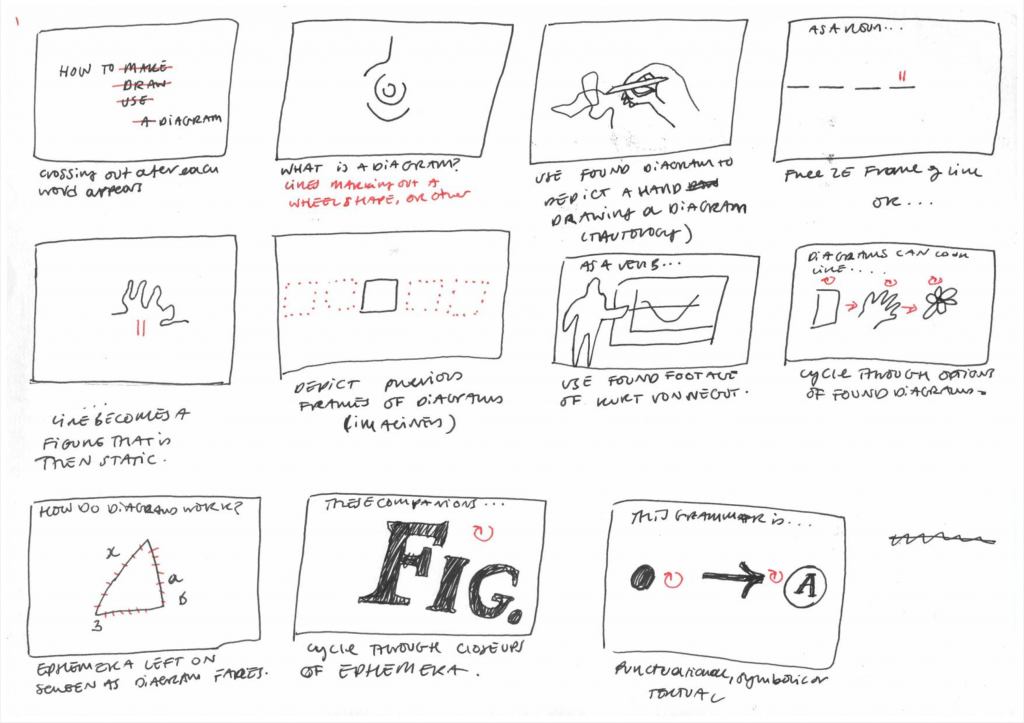
How to make
draw
use
a diagram
What is a diagram?
It’s a gesture.
It’s taking a line for a walk, and stopping it in its tracks.
It’s a drawn figure that represents the function, workings or appearance of an action, concept or thing.
It’s an instruction, a recording, a potential.
It’s a noun and a verb; one diagrams a diagram.
As a noun a diagram is a line — static — a freeze frame of an action.
The actions that precede and succeed this freeze frame are concealed; the diagram includes only the most important information in its stroke.
As a verb, to diagram is to gesture in the pursuit of recording or creating knowledge. The act of diagramming is multipurpose.
Diagrams can look like this,
or like this,
or anything in between.
They can elucidate, obscure, preserve, instruct or potentiate.
They make visual the ambiguous.
The word diagram evolved from the Greek ‘diagraphein’; literally meaning to mark out through lines.
But, to mark out through lines is an ambiguity — it could mean anything from writing and drawing, to chalk rubbing or computer aided design.
So where do diagrams fit between these things? And why are they important?
———————————
How do diagrams work?
A diagram is not a lone wolf. Often, they need help to be understood. I think of this help as a kind of graphic diaspora.
These companions to visual figures direct the reader around the page.
This orientational grammar is often punctuational, symbolic or textual.
Without the diagram, the diaspora becomes a concrete poem, a short equation, or lopsided alphabet. But do these fragments not work in the same way as the diagram? They position the reader, becoming an instruction of how to read the diagram itself.
This is diagrammatic language; an extension of the gesture that the diagram foregrounds.
They are directions, or roadmaps perhaps.
They are the bones on which the flesh of the diagram rests, and can invoke action in the same way instruction does.
Without this grammar underpinning it, a diagram is reduced to a few exacting strokes; it becomes an abstraction of a concept. Therefore a diagram depends on context. It must be situated — be it by punctuation, practice, print or the prose around it. A diagram must match its surroundings to be put to use.
———————————
What do diagrams mean?
Diagrams mean instruction
Diagrams mean recording
Diagrams mean potential
Diagrams are temporal actors — they affect the past, present and future of an action.
A diagram is an instruction, but also a recording; it archives the doing or knowledge of a thing and serves as encouragement to repeat it.
The lineage and physicality of these figures have sustained communities of practice for centuries. As inhabitants of blackboards, library books and notes on napkins, diagrammatic figures trace the pedagogical pursuit through a combination of gesture and line.
They are at once definite in their abilities to preserve, yet slippery in their modes of interpretation. A diagram showing someone how to make something can’t guarantee that the same result is yielded every time.
It’s a catalyst for making; and yet despite a diagram’s efforts to produce the quantifiable, it cannot ensure how its knowledge will be put to use — only the hand of a maker can do that. In this way, they are forever interpreted and re-interpreted. As compelling visual figures, their characteristics can be used to inform their original function — as instruction — as well as viewed outside of this, as pure image. Take this example. What do you see?
(Diagram minus instruction, possible answers popping up on screen)
These figures are borne from the hand of an artist, though this creator is usually anonymous. Within its lines are potentials and possibilities that the diagram itself — and its creator — is unaware of. A diagram starts and ends with gesture, despite being constructed to minimise the awareness of that fact.
———————————
Recordings
What is the difference between a diagram and a drawing? Perhaps a provisional distinction can be drawn between the two; a diagram is a teaching device, providing insight into the way something functions, while a drawing is pure image.
A drawing provides a representation of something whose meaning can be impacted by the materials with which it was drawn, whereas a diagram tends to monochromatic, linear formations.
Diagrams record reality, where drawings can invent worlds. Though can’t drawings also act as documents, just as diagrams can prove the imagined? Diagrammatic figures provide recollections of how actions took place in order for them to be repeated, or visualise knowledge in such granular detail so as to preserve it as fact. A drawing may do this as well, but it is not depended on as an authoritative, quantifiable representation of knowledge. The lines themselves are blurry, however, despite a diagram’s proclivity for accuracy. Is this a diagram, or a drawing? Perhaps it is both.
What about this?
What about now?
————————————
Instruction
What is a diagram instructing you to do? We know that the grammar around a diagram instructs you to read the figure correctly, but the content of the diagram itself is instructional as well. It is there for you to learn from, regardless of whether its purpose is for you to make something, or know something, or both.
But followed exactly, an instructional diagram would teach you how to replicate itself; grammar and all. Therefore, a type of projection takes place when reading a diagram. We make it perform for us so that it is functional. In our minds, the diagram is not static, but moving; we map it onto our own situation. The hands within a diagram become our hands, and we see the connection between the lines in the figure and the object in front of us, no matter how abstract the translation. In this way, a diagram is instructing us to forget itself. It must be anonymous — near invisible — so we can make it useful for our own purposes. Often it is not the diagram itself that we are interested in, but what it can offer us.
—————————————
Potential
Though rooted in recording reality, the potential of a singular diagram is multitudinous.
Gestalt theory dictates that we seek methods of making meaning from disparate information by forming patterns where they aren’t intended.
Take this spread, for example.
We see first the contextless diagrams, making connections between the visual elements on a page before their meaning is situated by the text surrounding them. The potential of these diagrams is liberated when we see them for their aesthetic value, rather than solely their functionality.
The lines of a diagram are active,
seismic.
They vibrate with possibility; and aren’t limited to what is depicted on the page.
They potentiate; a diagram is a map of, and instruction to, gesture. Diagrammatic practice underpins educational possibilities. Instructional handbooks containing diagrams are important archives of dying crafts, or knowledge in danger of vanishing. More than photographs of these crafts, or the resulting crafted items, a diagram provides a recording of how one might make an item again — ensuring communities of practice don’t go extinct. Perhaps the diagrams themselves should be archived — they are pillars of knowledge.
We know the story of a diagram is not linear, despite its aesthetic, and it doesn’t only exist in the past. Perhaps a diagram doesn’t ensnare singular meanings, but provides an archive of gestures and knowledge to be endlessly reinterpreted. Diagrams, therefore, are shapeshifters through time; weaving together knowledge and line only to be untangled by studious hands and curious eyes.
Leave a Reply